The Glamour Shortcut: What Casino Portrayals Leave Outside the Frame
Casino media literacy helps young viewers spot missing context, limit claims to what a scene supports, and discuss portrayals without treating them as fact.
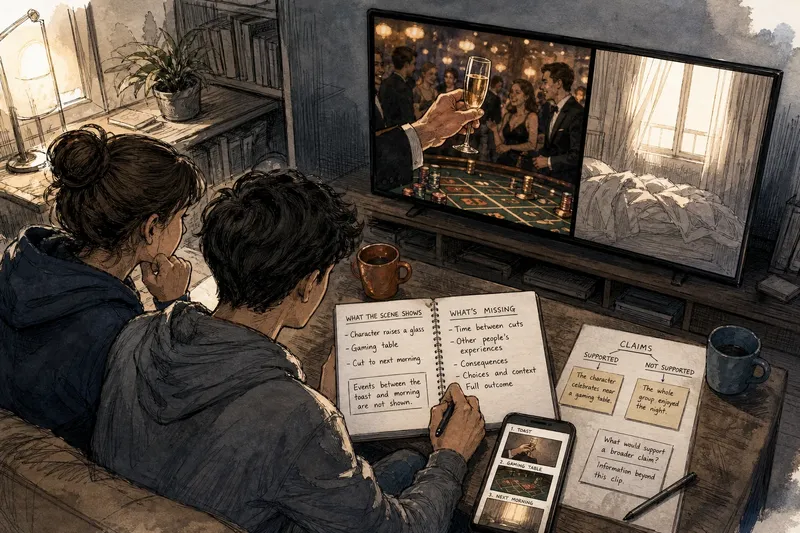
Casino media literacy means noticing what a scene cannot tell you, not just what it shows. When a character celebrates beside a gaming table, the scene alone cannot establish what happened before, what followed, or how anyone else experienced the night.
Start with the frame
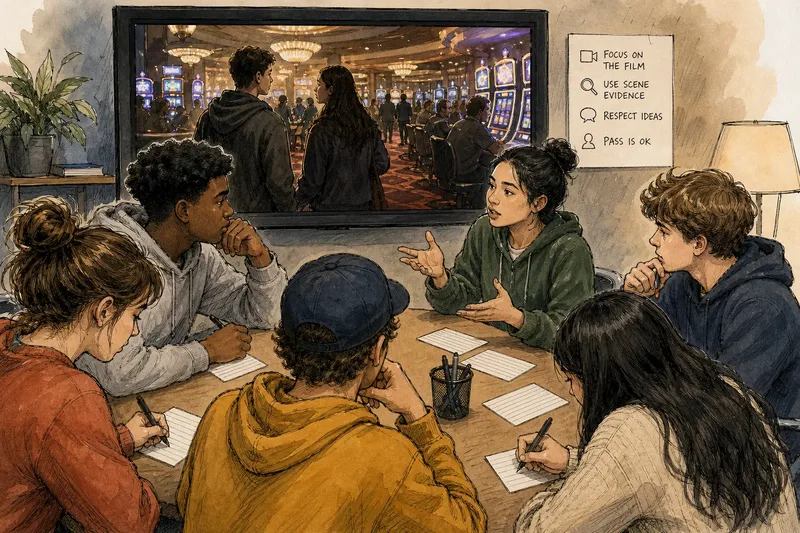
Choose a short scene from a film, show, or advertisement. Agree that the conversation is about how the scene is made, not whether a young person has the “right” reaction or should gamble.
Watch once without pausing. On a second viewing, note the opening moment, the ending moment, and any cuts between events. A phone note or sheet of paper works. Those boundaries matter because editing can leave out time, people, and consequences without signaling what they were.
Pause or switch scenes if the subject feels uncomfortable. A young viewer does not need to defend a reaction or continue a conversation they do not want.
Map the omissions
Look beyond visible details to the gaps the scene creates. Record what the edit leaves unresolved rather than guessing what happened offscreen.
- Time: If the scene jumps from a celebration to the next morning, mark the intervening events as unknown; if it follows the action continuously, describe only the span it shows.
- People: If the camera stays with one character, note whose perspective is missing; if several people appear, do not assume the scene represents anyone who is absent.
- Consequences: If the scene ends before anyone responds to an event, leave the outcome open; if a response appears, describe that character’s response without extending it to others.
- Choices: If the edit shows a decision but not what shaped it, note that missing context; if earlier events are included, distinguish what the scene states from what it merely suggests.
- Sound and pacing: If music or quick cuts make a moment feel exciting, name that production choice; if the scene is quiet or prolonged, discuss how that changes its mood without calling either treatment typical.
- Purpose: If the clip is an advertisement, treat its invitation as persuasion; if it is fiction, discuss how the scene serves the plot rather than treating it as a report.
Each item leads to a decision: keep a claim within the shown material, or label the missing part unknown. The scene may support “the character raises a glass”; it does not, by itself, support “everyone had a good night.”
Limit real-life claims
Stories and advertisements select details for different purposes. A drama may use a casino as a setting for conflict or celebration. An advertisement may present a carefully chosen invitation. Neither gives a complete account of a venue, a person’s experience, or what happens beyond the scene.
When someone draws a broad conclusion, ask what kind of claim it is. A claim about the scene can be checked against what is visible or spoken. A claim about real people or places needs information beyond a brief portrayal; if that information is absent, leave the claim undecided instead of treating the scene as evidence.
What can the gaps tell you?
What happened between cuts?
Write down the last event before the cut and the first event after it. Treat everything between them as unknown unless the scene supplies it elsewhere.
Whose experience is missing?
Notice who gets a close view, dialogue, or reaction. If other people are outside that viewpoint, do not infer their feelings or outcomes from the featured character.
What does the editing encourage?
Look at music, camera focus, and the moment the scene ends. If those choices make the setting seem inviting or tense, describe that effect as a reading of the scene, not as proof about real venues.
What would support a broader claim?
A short clip can support a statement about its own images and dialogue. A claim about real-world experiences calls for information from outside the clip; without it, say that the scene does not answer the question.
Work through a scene
Imagine you and a teen watch an invented drama clip. Its starting details are a character raising a glass, a brief view of a gaming table, and a cut to the next morning. First, enter those three observations in a phone note, one per line. Next, add a fourth line: “Events between the toast and morning are not shown.” Then sort the possible claims. “The character celebrates near a gaming table” fits the images. “The whole group enjoyed the night” does not, because the clip gives no account of every person or the missing hours. The decision is to discuss the scene’s celebratory presentation while leaving the group’s experience unknown.
If the teen says the clip looks inviting, ask which choice shaped that impression: the music, the close-up, the toast, or something else. Their answer identifies a reading of the scene without turning that reaction into a claim about everyone who watches it.
Keep the claim narrow
If viewers disagree, return to the edit: where it begins, where it stops, and whose experience it follows. People can interpret the same choice differently. They can also agree that an omitted event remains unknown.
Casino media literacy is strongest when a young viewer can name both the scene’s message and its limits. Keep the final claim tied to what the clip actually provides; when it reaches beyond that, ask what outside information would be needed before deciding.